
Madison Education Partnership (MEP)
About the Partnership

The Madison Education Partnership (MEP) was established in 2016 as a research-practice partnership (RPP) by leaders of the Wisconsin Center for Education Research (WCER) and the Madison Metropolitan School District (MMSD).

MEP brings together UW–Madison researchers and MMSD staff to define and address critical issues relating to student achievement and equity in the Madison school community.
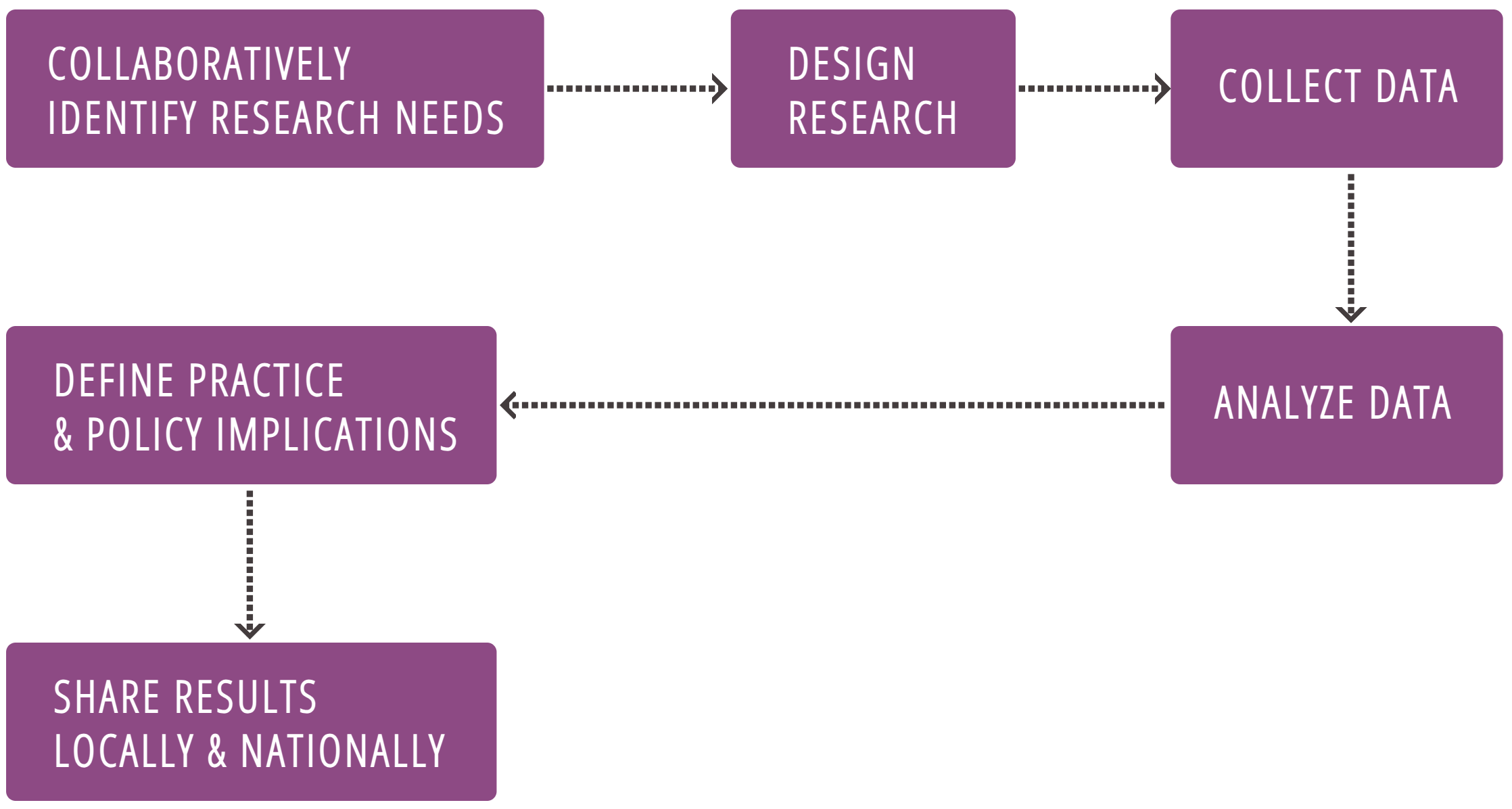
A clear research cycle is coordinated through MEP. Critical questions within MMSD are brought to the MEP discussion table. UW and MMSD representatives collaborate to set priorities, design a research strategy, identify data to collect, and set up analyses that will lead to a deeper understanding of the issues and implications, as well as potential responses by district leaders, policymakers, and other stakeholders.
Faster turnaround of research and analysis is one of the many advantages of MEP. Results are shared with decision-makers immediately following analysis (rather than later, after journal publication), so that district leaders can use findings to make strategic policy and practice decisions. Though quickly accomplished and locally-based, MEP’s research is up to peer-review standards and has national relevance.
Advantages of Research-Practice Partnerships
- Mutually defined questions and priorities
- More efficient data sharing
- Highly qualified researchers leverage university resources
- Faster turnaround of results for decision-makers
- Increased likelihood of research use
Across the nation, research-practice partnerships are working on local problems with national consequences. Learn more from the National Network of Education Research-Practice Partnerships.
Theory of Action
Why do we engage in a research-practice partnership?
We join research and practice to increase educational equity by enhancing the opportunities for historically underserved groups. We work locally but believe what we learn in Madison can also inform us as we strive for educational equity in other places. MEP creates a space for researchers and practitioners in Madison to collaboratively engage in high-quality, problem-based research that contributes to policy, practice and broader understandings of educational processes
What resources do we bring to this work?
We leverage the strengths of UW faculty, staff, and students, as well as MMSD staff, students, and parents. We can use MMSD’s existing administrative data and the expertise of their Research & Program Evaluation Office staff. We have MMSD and UW leadership support and existing relationships within and across organizations. We also have a community network to connect us to Madison’s greater strengths and challenges.
How do we do this work together?
We are mutualistic, with shared power between members of the school district and the university. We are committed to equity and reducing gaps in opportunity and achievement. Our partnership is built on trust and an understanding of mutual, long-term benefit.
What do we do?
We produce original research on mutually agreed-upon problem(s) of practice that results in research briefs, academic publications, memos and presentations. We build capacity to produce, understand and use research in MMSD by facilitating research opportunities and creating venues to
discuss findings. We connect research findings to broader conversations about educational equity and outcomes through meetings, presentations, blog posts, and podcasts
What will change as a result of our work?
In the short term, we will integrate research into discussions around MMSD programs, policy, and practice; develop the capacity of MMSD staff to produce, understand, and use research; foster work from UW researchers that is tied to district problems of practice in collaboration with MMSD; and produce high-quality, publishable research that is enabled by the relationships we have built and
continue to sustain.
In the long-term, we will improve experiences and outcomes for MMSD students and increase equity in outcomes for MMSD students. We will also enhance the educational research capacity of
the University by building relationships that facilitate deep, sustained and genuine collaboration around significant problems of practice in education.
MEP’s Structure
MEP Directors
MEP Directors oversee all MEP operations and direct research projects. Along with staff based at WCER, they engage with local stakeholders, MMSD leaders, school practitioners, and supported researchers—to advance studies and results sharing, and to support practice and policy changes related to student achievement and equity.
Supported Researchers
Supported Researchers were awarded grants to carry out research projects that complemented the research conducted by the MEP Directors.
Affiliates
Affiliates are UW–Madison faculty and staff who are engaged in supported research projects within MMSD.
Interns
Interns are graduate students who work with MEP to identify and execute collaborative research projects in MMSD. These intern researchers, many of whom hail from UW–Madison’s Interdisciplinary Training Program (ITP) in Education Sciences, represent diverse disciplines within the social sciences and education and partner with MMSD staff member(s) to apply their knowledge and skills in practical settings. Interns design and conduct research and/or translational projects to provide the district with deeper contextual information topically aligned with current MEP research areas and of interest to district leadership.
Council of Advisors
An Advisory Council made up of UW faculty and MMSD staff to (1) advise MEP directors and staff on key decisions for the partnership’s growth and development, use and distribution of research products, and ways to sustain the partnership; (2) provide thoughtful reviews of new lines of work, grant proposals, and research products prior to release; and (3) share information about MEP’s mission and work with others in their networks.
MEP Research Cycle
WCER and MMSD leaders and researchers mutually define and investigate problems relating to student learning, equity, and district-wide concerns, then collaboratively identify responsive policies and solutions based on results.
This diagram is a simplified picture of MEP’s iterative research process.
Research Findings
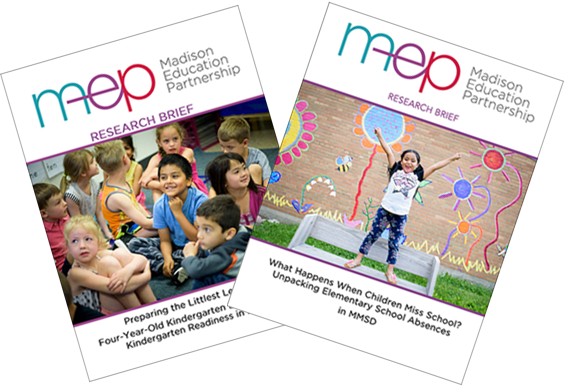
Research Briefs are one way MEP shares its work.